Ball layout, drilling and motion. One system.
Architect is built for the person who owns the pro shop. Every ball with verified specs, a layout engine that speaks every system you use, live USBC validation, and a drill sheet that replaces the paperwork you juggle today.
Live today, built with working pro shops. Early access is free while it’s shaped by the shops using it.
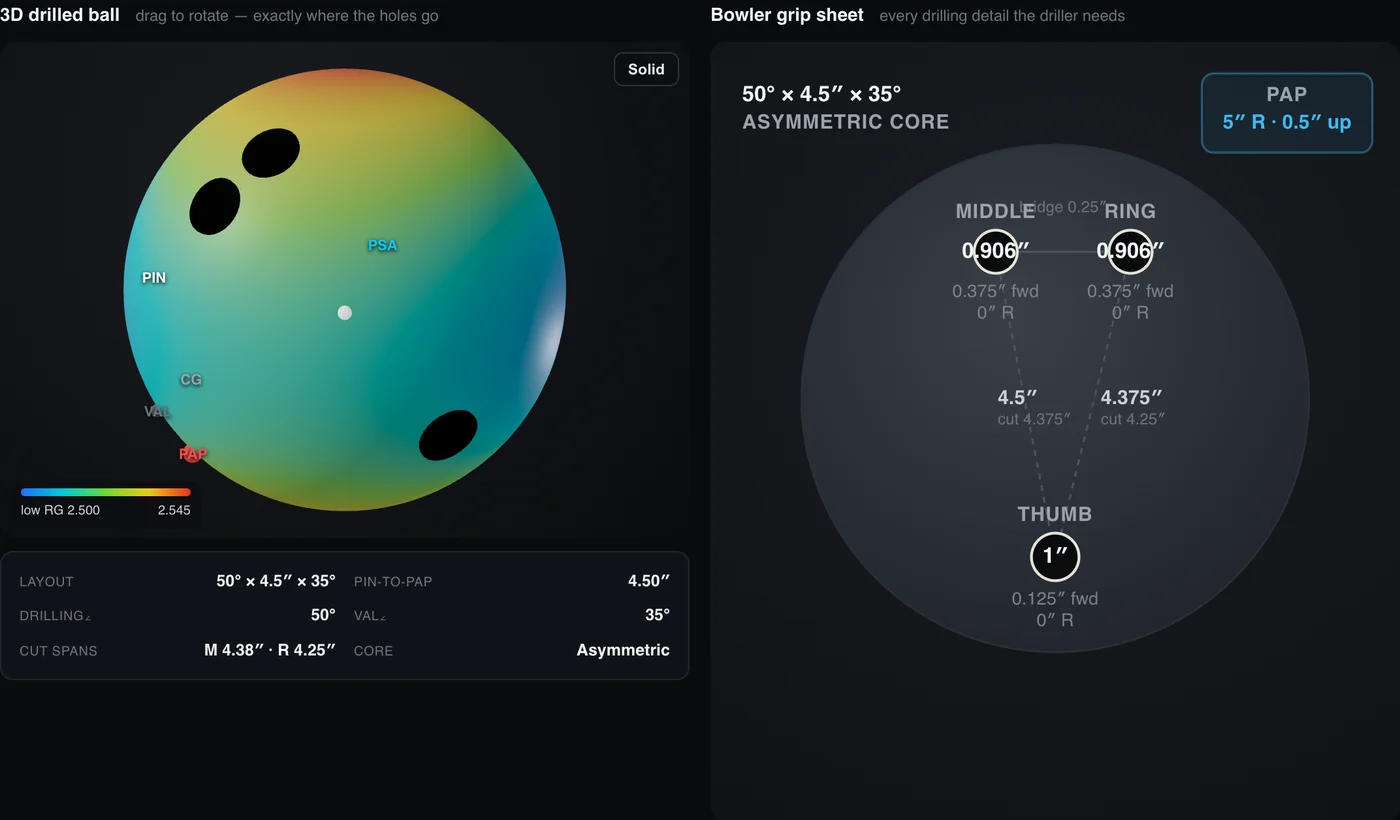 The actual product — a live job in the builder
Five things to hold together, and no single tool that does it
A ball goes out the door only after you have solved all of these at once — usually across paper, a spreadsheet and memory.
- Which ball to sell
- Specs are scattered across manufacturer pages, PDFs and third-party databases, and the numbers that matter change with the weight you are actually drilling.
- What layout to use
- Free spreadsheets, a decade-old PDF, and static charts per manufacturer. Nothing live, nothing that covers every brand in one place.
- Reading someone else’s numbers
- A layout written in one system is hard to read if you think in another — so a customer’s existing ball becomes guesswork instead of information.
- What was done last time
- Plugs, redrills and surface changes live on paper or in your head. There is no standard record for the history of a single ball.
- Explaining it to the customer
- The reason a layout will work is a technical argument, and it gets made verbally with a marker on a ball.
Everything from measurement to handoff
One place for the whole job, so nothing gets re-entered and nothing gets lost between the counter and the drill press.
Wall library
Every ball, with specs recorded per weight rather than a single number — because the weight you are drilling is the one that matters. Your own stock first.
Multi-system layout engine
Dual-Angle, Storm VLS, Storm 2LS and PAL, each with its own parameters, units and reference points. Work in whichever one you think in.
Read any layout
See the same drilling expressed in another system, so a customer’s existing ball stops being a mystery.
Live USBC validation
Every layout checked against the current specifications before you cut, with the rule and its limit named. The ruleset is versioned, so a revision does not silently rot.
One drill sheet
The hand-fit sheet and the layout card as a single page, ordered the way you already read it — and complete enough that whoever drills it needs no conversation.
Ball history
Every plug, redrill and surface change kept against the specific ball, with resurfacing prompts when a surface is due.
Show them why
A second screen facing the customer shows the ball and the layout — never your cost, your supplier or your notes. It clears itself between customers.
Fit that carries forward
Spans, pitches and grip recorded once, with the measurement convention stored explicitly so the numbers never become ambiguous.
Motion prediction
Physics-based prediction of what a ball will do on a given pattern, across every brand — with its confidence shown honestly, never as a guarantee.
The argument you make with a marker, made visible
A layout is a geometric relationship between the ball’s core and the bowler’s axis. Architect draws it, checks it, and shows it to the customer.
What the drawing shows
Schematic, drawn to explain the construction rather than to scale. Architect renders the real geometry for the specific ball and bowler in front of you.
Four systems, one record
Dual-Angle
drilling° × pin‑to‑PAP″ × VAL°VLS
pin‑to‑PAP × PSA‑to‑PAP × pin buffer2LS
pin‑to‑PAP × pin‑to‑grip‑centre × PSA‑to‑PAPPAL
pin‑to‑PAP × MB‑to‑PAP × pin‑to‑lineFrom the counter to the drill press
The counter and the bench are two different jobs, often two different people. The printed sheet is what carries the work across.
Plan
Pick the ball, choose the layout system, set the numbers.
Validate
Checked against current USBC specifications before anything is cut.
Show
Turn the screen around. The customer sees the ball and the layout.
Approve
Their approval is recorded against exactly what they agreed to.
Hand off
Print a complete sheet, stamped with its revision, and send it to the bench.
Live, and built in the open with shops
Architect is running in real pro shops today. It was specified from primary sources, validated with working shops, and every release ships against a live test suite.
- ✓The full shop workflow is live. Build the job, show the customer on a second screen, record their approval, and print a drill sheet that is frozen at approval — a later edit can never change what the bench cuts from.
- ✓The Wall: 8,000+ USBC-approved balls. Refreshed weekly from the official list, with per-weight specs, coverstock, core and factory finish where published — and official product imagery.
- ✓Physics you can defend. As-drilled mass properties, an RG-contour ball view, and a lane simulation calibrated against a 90-drilling reference set — every prediction carries an honest confidence band, never a guarantee.
- ●Founding shops are shaping the roadmap. Their feedback has already changed the product — from the DV8 Pin-to-Dot converter to field-level control of what a customer sees. Pricing lands with the first paid tier; founding shops keep preferred terms.
Tell us how your shop actually works
If you run a pro shop, the most useful thing you can do is show us where the current process hurts. Early access goes to the shops who help shape it.